Last updated November 21, 2026
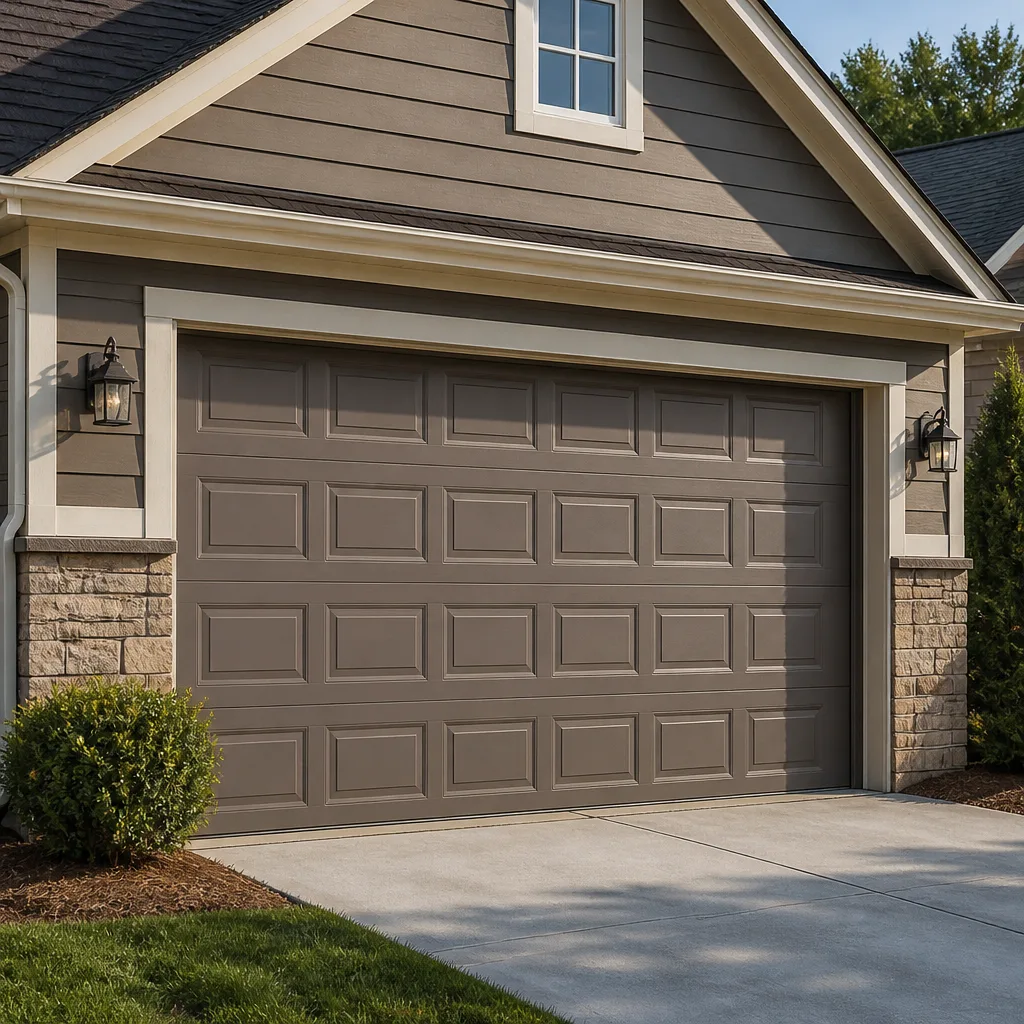 Raised-panel steel
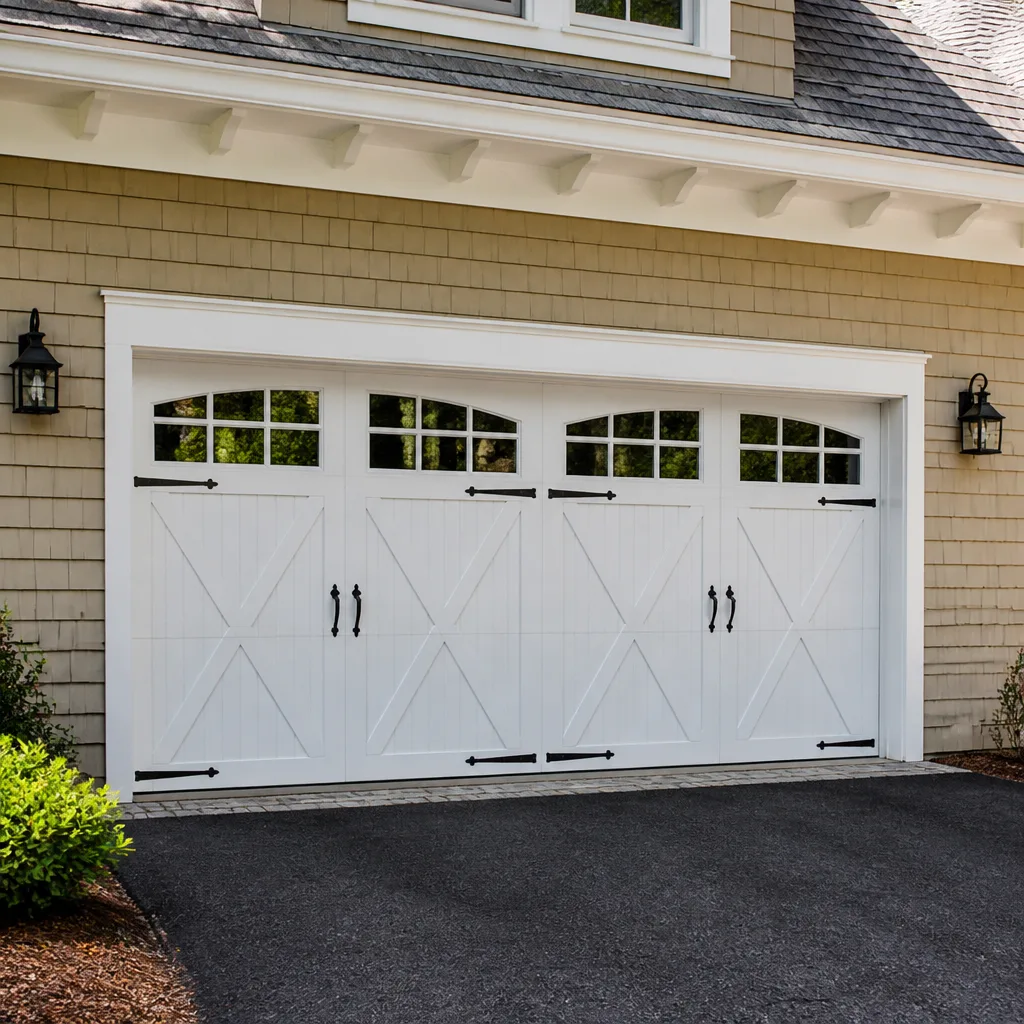 Carriage house
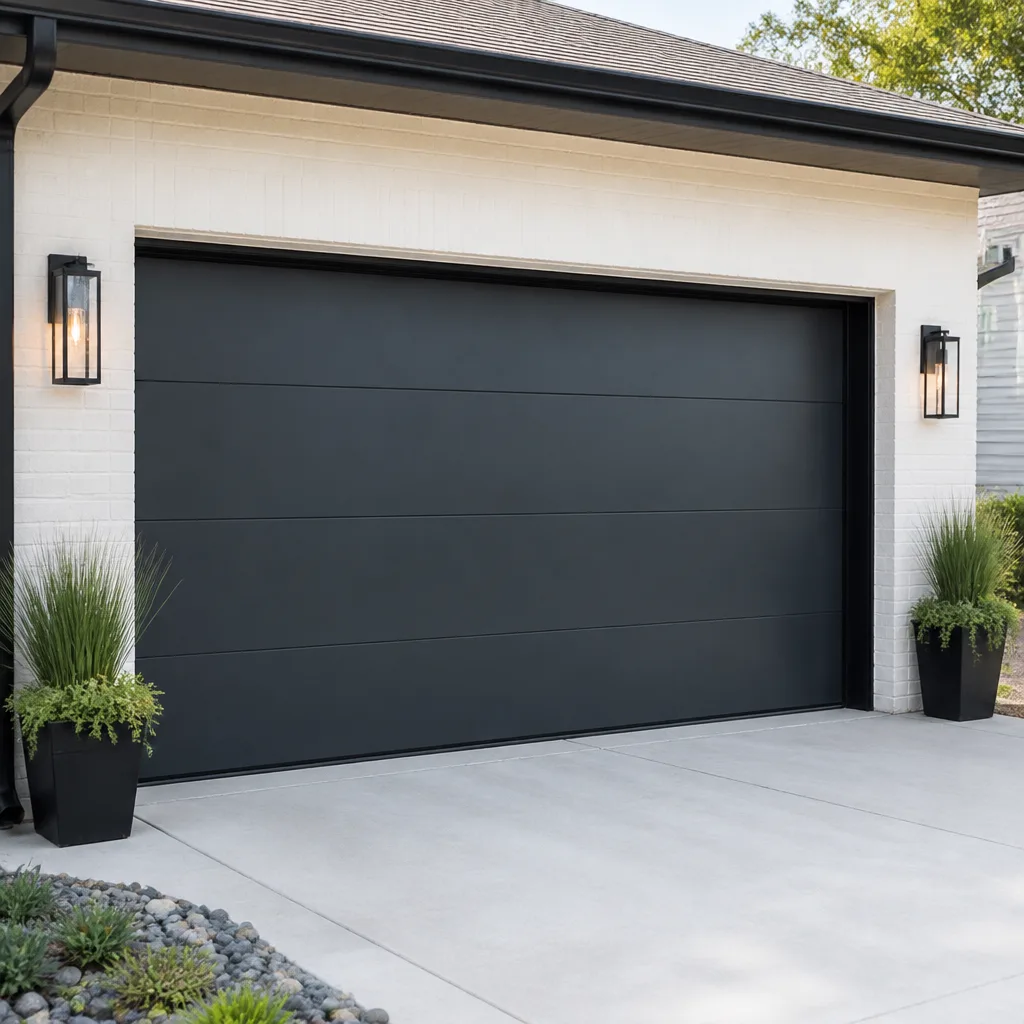 Modern flush
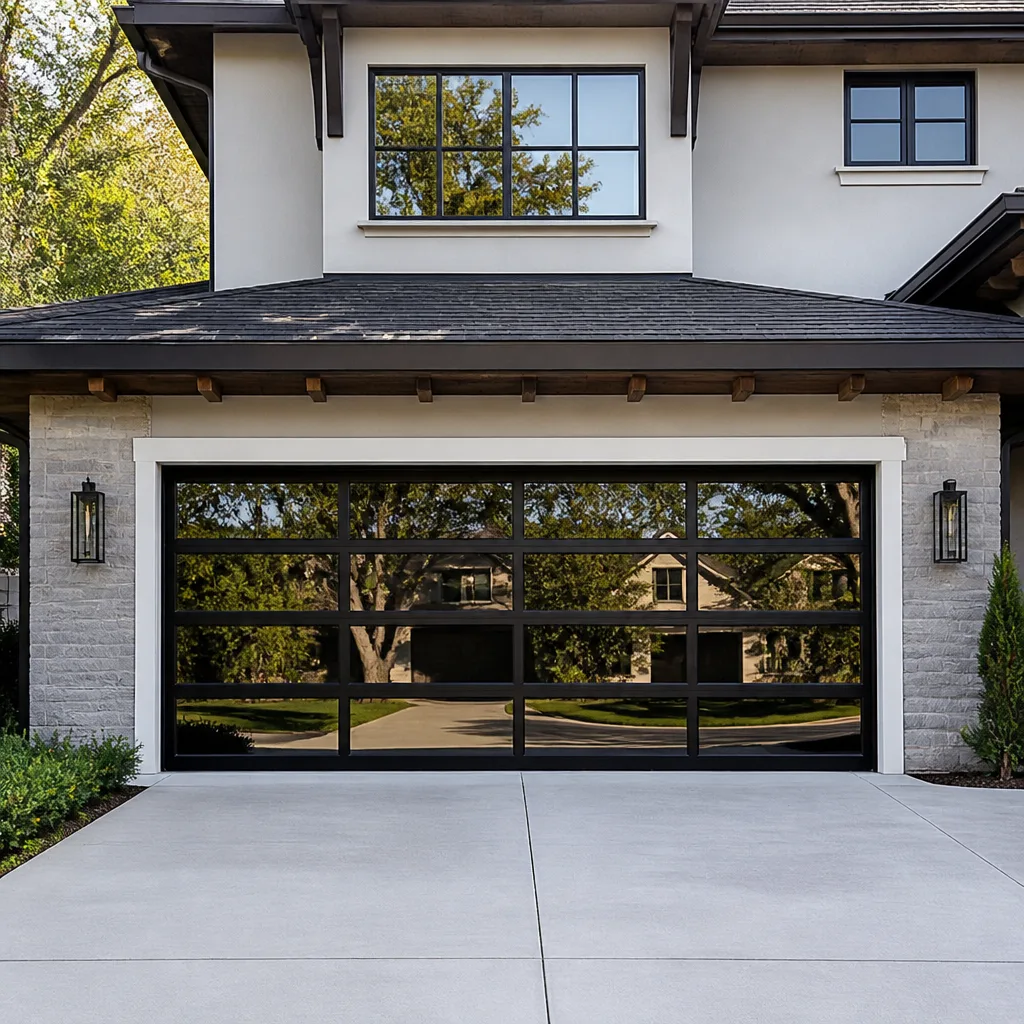 Full-view glass
 LiftMaster openers
 Chamberlain openers
Full 25-point door and opener safety check with every visit - springs, cables, rollers, tracks, and your LiftMaster or Chamberlain opener included
You get a price before we start. It does not change when the pro arrives.
Get your free estimateGarage Door Warning Signs: A Hialeah Homeowner’s Reference Guide
A garage door that’s about to drop a broken spring doesn’t go quiet – it gets louder. Most doors that fail in Hialeah announced the problem days or weeks ahead, with a grinding, a pop, a door that sagged a little lower on one side, and the homeowner heard it and filed it under “that’s just how it sounds now.” That’s the gap this guide closes. Knowing the difference between a door that’s aging normally and one that’s days from failure is entirely learnable, and it doesn’t require touching any hardware. Below you’ll find the sound-and-behavior patterns that point at specific parts, the visual signs of an imminent spring failure, and the line between “book a repair” and “don’t use that door again.”
Quick Answer
Garage door warning signs in Hialeah fall into four groups: sound changes (grinding, popping, scraping, squealing), visual signs (spring gaps, cable fraying, sagging panels, worn rollers), behavioral changes (slow travel, uneven movement, jittery starts), and opener symptoms (erratic reversals, mid-travel stops). Doors that strain, scrape, or stall are signaling a failing part through the door’s own movement. Anything involving a snapping or gapped torsion spring, a slack or broken cable, or a door that will not stay up is an emergency – stop using the door and call a professional.
Styles & brands we work with
- Raised-panel steel
- Carriage house
- Modern flush
- Full-view glass
- LiftMaster openers
- Chamberlain openers
Table of Contents
- The Audio Diagnostic: What Each Sound Tells You
- Visual Inspection: Spotting an Imminent Spring Failure Without Touching It
- Why Slow Operation Is a Serious Warning in Hialeah’s Humidity
- Your Opener as a Diagnostic Tool
- Emergency Risk vs. a Scheduled Repair Window
- Aging Normally vs. Days From Failure: The Comparison
- How Humidity and Heat Affect Each Component
- A Five-Minute Check That Catches Problems Early
- Common Mistakes to Avoid
- When to Call a Professional
- Frequently Asked Questions
The Audio Diagnostic: What Each Sound Tells You
Sound is the earliest signal a garage door gives you, and it’s the one homeowners dismiss most. A door that has always been quiet and now has a voice is telling you which component is under stress. You don’t need to open a panel to run this diagnostic – just stand in the driveway while the door cycles and listen.
- Grinding, low and constant: usually worn rollers or a dry hinge. The metal-on-metal rumble means moving parts are running without lubrication or a roller’s bearing has seized. It’s a maintenance-level problem now and a heavier repair later, so it’s worth addressing early.
- Popping or a sharp snap: the loudest warning in the set. A pop during travel often points at a torsion spring under stress or a cable taking the load unevenly. A single loud snap followed by the door refusing to open usually means a spring has broken. Stop here and treat the door as unusable.
- Scraping, high and intermittent: a panel is rubbing against the track or the frame. Scraping on a Hialeah door is often the result of panel sag caused by cable tension that isn’t balanced left to right.
- Squealing or chirping: usually rollers or a dry opener rail. Squeal is the friendliest sound on this list – it’s usually lubrication or a part swap, not a failure warning.
- A grind that gets louder over weeks: the door is slowly losing a component. This is the category that ages into failure if ignored.
In our experience, the doors that fail with no warning are rare. What’s common is a door that made a new sound, and the owner stopped noticing it after a week. Write down the sound once, note the day, and watch whether it grows louder or more frequent. A sound that is stable for a month is different from a sound that changes weekly.
Visual Inspection: Spotting an Imminent Spring Failure Without Touching It
You can check for a spring that’s about to fail without touching the hardware, and you should. Torsion springs – the horizontal springs on the shaft above the door – are the most mechanically dangerous part of a residential garage door in this climate. When they let go, they release stored energy in a fraction of a second, with enough force to break bones. So treat this as a look-only inspection.
- Look for a gap. A healthy torsion spring is one continuous coil. A gap along the length of the coil, or a coil that suddenly widens, is a sign the spring has already broken or is about to. Do not try to close the gap or take tension off anything.
- Look for rust bloom. In Hialeah’s heat and humidity, rust often shows first on the spring wire, at the ends, and at the shaft. Surface discoloration is normal; a pitted, crusty spring or a steady line of rust along a coil is a sign of stress.
- Look for sag. Stand back and look at the door’s bottom edge. A door that is lower on one side than the other often means the springs aren’t carrying the same load left and right.
- Look at the cables. Cables run down each side of the door alongside the tracks. Frayed strands, kinks, or a cable that’s slack and drooping instead of taut are warning signs. Slack cables often mean a spring or drum has failed.
- Look at the springs themselves, not the opener. The opener is the last link in the chain. A door that opens slowly but the opener sounds normal is usually a spring or cable problem, not an opener problem.
- Look at the wall above the door. A torsion shaft that has visibly shifted in its brackets, or a bracket that’s pulled away from the wall, is a serious sign and often points at spring tension that isn’t balanced.
If any of those signs lands, don’t open or close the door with the automatic opener. Use the manual release only when you need to get the car out, and only with your hands low and clear of the tracks. Then call for a professional inspection. We handle spring replacement as a named specialty precisely because it’s the one repair that no homeowner should take on with a hobby toolset and an internet video.
Why Slow Operation Is a Serious Warning in Hialeah’s Humidity
Slow operation on a garage door in Hialeah is not a symptom to shrug off. In drier climates, a sluggish door is often just a tired opener or a dry roller. Here, a door that’s slower than it used to be is a symptom worth flagging because the combination of heat and humidity in South Florida is hard on the parts that carry the door’s weight – the springs, the cables, the drums they wrap around, and the bearings in the rollers.
Here’s what’s going on: the cable that winds on the drum at each side of the door carries equal load only when both sides are relaxed to the same tension. When the drum is sticky, when a bearing seizes, or when a cable has stretched, the door doesn’t move with equal force on both sides. The opener gets a resistance signal on one side more than the other and slows the whole cycle. That’s why slow operation frequently appears before any obvious visual sign of a problem.
Slow travel on a Hialeah door is worth watching closely when it comes with any of these companions:
- The door starts slowly and then speeds up in the last third of travel.
- One side reaches the top or bottom before the other.
- The bottom of the door isn’t parallel to the driveway when closed.
- The opener’s light flickers or dims while the door is moving.
A door that slows gradually over months is a maintenance-level signal. A door that slows suddenly over a week, especially in the heat, is worth a professional look sooner. The slower movement is how the door is telling you a component is binding – and a binding cable or drum is exactly the kind of thing that fails hard rather than wearing out gently.
Your Opener as a Diagnostic Tool
Your opener is the most underrated diagnostic tool in the garage. Homeowners read it as a motor that either works or doesn’t. In practice, the opener’s behavior – its reversals, its mid-travel stops, its remote lag – tells you as much about the door’s mechanical state as it does about the opener. The opener is the thing that applies force to a door, so it’s the thing that reacts when force gets resisted.
- Erratic reversals. A door that opens partway and then reverses is usually reading resistance. On a LiftMaster or Chamberlain system, the opener’s safety sensor or travel limit logic is doing its job. The cause is more often a binding cable or door track than a sensor – don’t assume the sensor is the problem just because the door reversed.
- Mid-travel stops. A door that stops hard in the middle of its run but starts again on a second press is usually an opener limit switch drifting out of position, but it’s also a common pattern on a door whose panel weight has changed, which happens with a sagging panel or a spring that’s lost tension.
- Remote lag. A remote that needs to be pressed twice, or works from inside the garage but not the driveway, usually points at the opener’s antenna or a receiver, not the door. But a remote that lags only when the door is opening is often a sign the opener is browning out under load, which comes back to door friction.
- A bright opener light that dims during travel. On a Genie or LiftMaster opener, this is usually a sign the opener is working harder than it should be. A door that is balanced correctly draws little effort from the opener; a door that’s not, drags it.
- The opener runs but the door doesn’t move. Either the opener’s carriage is disconnected or a spring has let go. If you can see that the springs still look intact, suspect the carriage and release the door manually before you touch anything else.
This is why garage door opener repair starts with the door itself. On a LiftMaster or Chamberlain opener, we can pull the diagnostic codes and confirm the opener is behaving within spec, but if the door’s friction is the cause, replacing the opener only resets the clock. Getting the opener diagnosed right the first time means checking the door’s movement and weight first, then the opener.
Emergency Risk vs. a Scheduled Repair Window
The hardest call a homeowner has to make is whether to keep using the door. Here’s the split. Signs that a door should be treated as unusable are the following:
- A broken spring. The door is now dead weight on the opener and on the cables. Never run the opener. The door is not safe to cycle.
- A visibly broken or unspooled cable. A loose, dangling, or frayed cable can whip or jam, and the door can drop.
- A door panel that has left its track. The panel needs to be treated as a hazard zone – it can fall or spring free of the track at any moment.
- A door that will not stay up when you lift it. This is the clearest sign that springs have lost their ability to hold the door, and a door that can’t stay up is a door that can fall.
- A torsion shaft that has shifted or a bracket that has pulled free. The load path is compromised, and every cycle stresses it further.
Signs that allow a scheduled repair window are the following:
- Grinding or squealing that has been stable for weeks and the door still travels at an even pace.
- A single slow section that hasn’t grown worse.
- A door that runs normally but has a remote or opener light issue.
- A door whose bottom seal is worn but which closes evenly.
If your door is on the emergency side, stop using it and call us – emergency garage door service is a standing part of what we do, not a seasonal add-on. If it’s on the scheduled side, we’d rather book a repair while the door is still opening than wait until it quits on a morning the car is in the driveway.
Aging Normally vs. Days From Failure: The Comparison
The most useful skill in this whole guide is the ability to tell a door that’s aging from a door that’s failing. The two look similar to a casual glance. They differ in shape:
- Aging normally: a quieter, steady sound. Days from failure: a sound that appeared suddenly and has grown louder.
- Aging normally: a door that moves at a consistent speed. Days from failure: a door that moves slower than it used to, or at inconsistent speed.
- Aging normally: a slight surface discoloration on springs. Days from failure: a gap in a spring coil, a pitted spring, or a cable that has gone slack.
- Aging normally: a door that’s slightly stiff in cold weather (rare in Hialeah). Days from failure: a door that’s stayed stiff or slow after a run of hot, humid days.
- Aging normally: a remote that occasionally needs a second press. Days from failure: an opener that reverses or stops mid-travel when it never did before.
- Aging normally: small rubber seal wear at the door’s bottom. Days from failure: a bottom edge that no longer sits parallel to the concrete.
Run the list once a season. A door that’s aging normally should show no more than one item in the right-hand column at any given time. Two or more is the signal to get a professional inspection booked. It’s the combination, not the single symptom, that matters in Hialeah.
How Humidity and Heat Affect Each Component
Hialeah is hot and humid for most of the year, and every component on the door responds to that fact. Understanding which parts wear faster in this climate tells you where to point your attention.
- Springs. Heat and humidity don’t rust a spring overnight, but they do make the wire more prone to surface pitting over time. Pitting is where springs start to fail first, so the look of the spring, not just the sound of the door, matters here.
- Cables. Cables rust and stretch. A cable that carried the door evenly for years can lose tension in high humidity and start to show slack on one side. Slack cable is the warning sign most closely tied to door drop.
- Rollers. A bearing that would spin freely in dry air can seize in humid air, especially on doors near an open drive. That’s a grinding sound, and it’s the most predictable humidity-related failure we see.
- Panels. Wood or wood-composite panels swell and shift in humid air. Panels that have swelled won’t sit flat in the frame, which shows up as a scrape and as a door that doesn’t close flush.
- Track. Steel track can rust at the mounting bracket points, which is often where a door starts to bind. Binding track is a “slower door” symptom before it’s a “door that won’t close” symptom.
- Opener. Opener electronics don’t love sustained heat, and a LiftMaster or Chamberlain unit that browns out under load during long open-and-close cycles in July is telling you the door is drawing too much effort.
This is why a full garage door repair inspection in Hialeah looks at the whole door rather than just the part that made the noise. The grinding roller is often not the whole problem; the bound cable that caused it is the root, and the humidity is why both are showing up now.
A Five-Minute Check That Catches Problems Early
Run this once a month and you’ll catch most failures with time to schedule a normal repair. You don’t need any tools, and you don’t need to touch the springs or cables.
- Stand in the driveway and open the door. Close your eyes for a moment and listen. Is the sound the same as it was last month? Note any new sound.
- Watch the door’s full travel. It should move at a consistent speed and the bottom edge should stay parallel.
- Check the springs from a step back. Look for gaps, coil pitting, or a spring that looks different from its neighbour.
- Look at both cables from a step back. Are they taut? Is there slack or fraying?
- Close the door and look at the gap between the door and the driveway. A gap on one side means the door isn’t closing flush; a gap along the whole width usually means the bottom seal is worn.
- Press the remote once. Did the door open first press? Did the opener light dim? Note anything new.
Write a one-line note each month. When something changes, you’ll catch it while it’s still cheap to fix. On the doors we see around Hialeah, the failures that surprise homeowners tend to be ones they were warned about a month in advance in the form of a sound or a slight change in speed.
See the difference
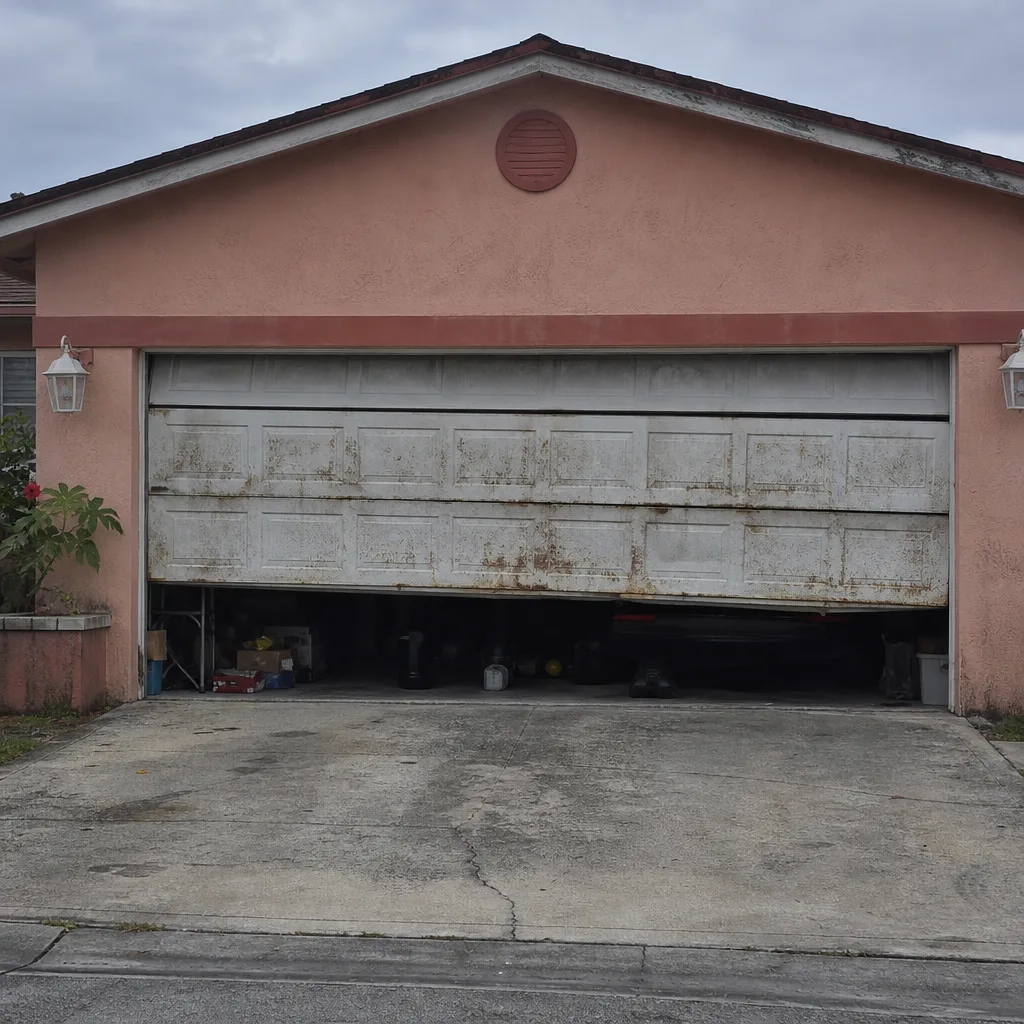 Before
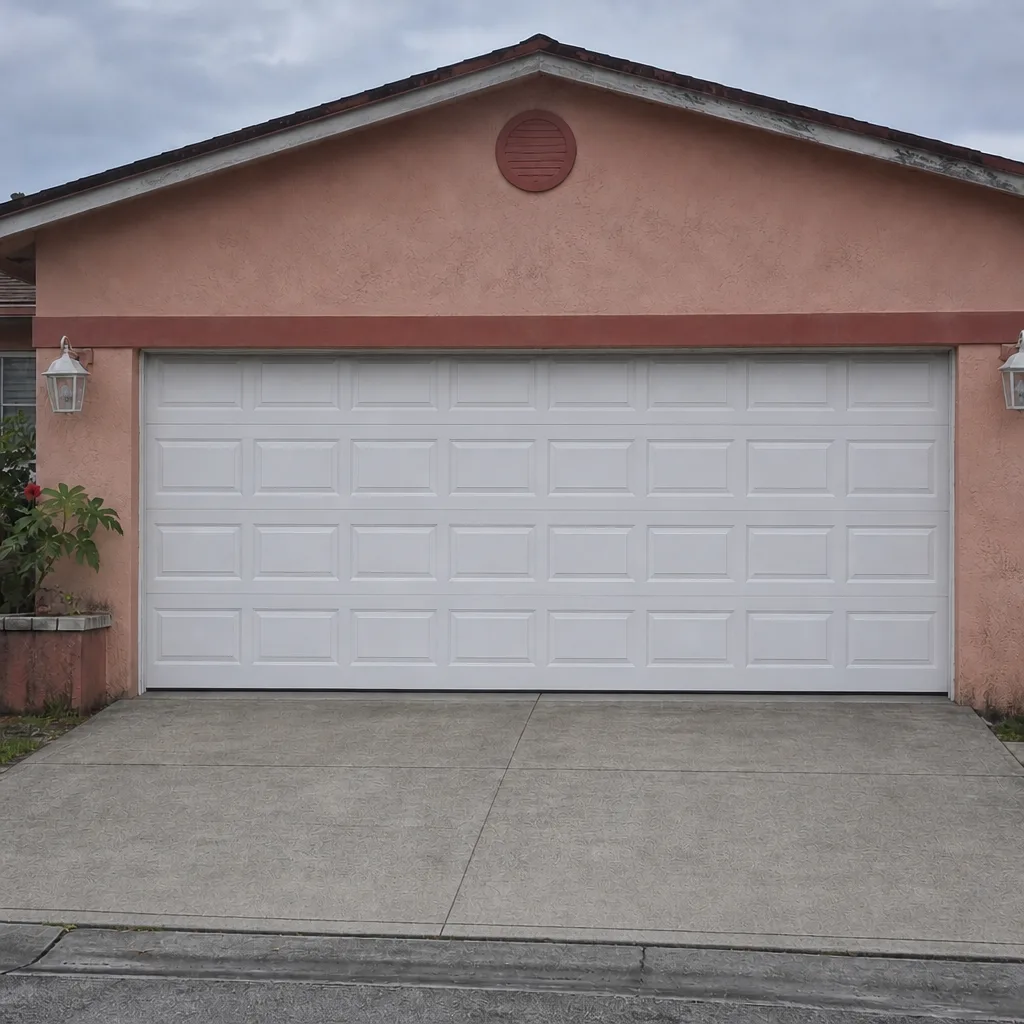 After
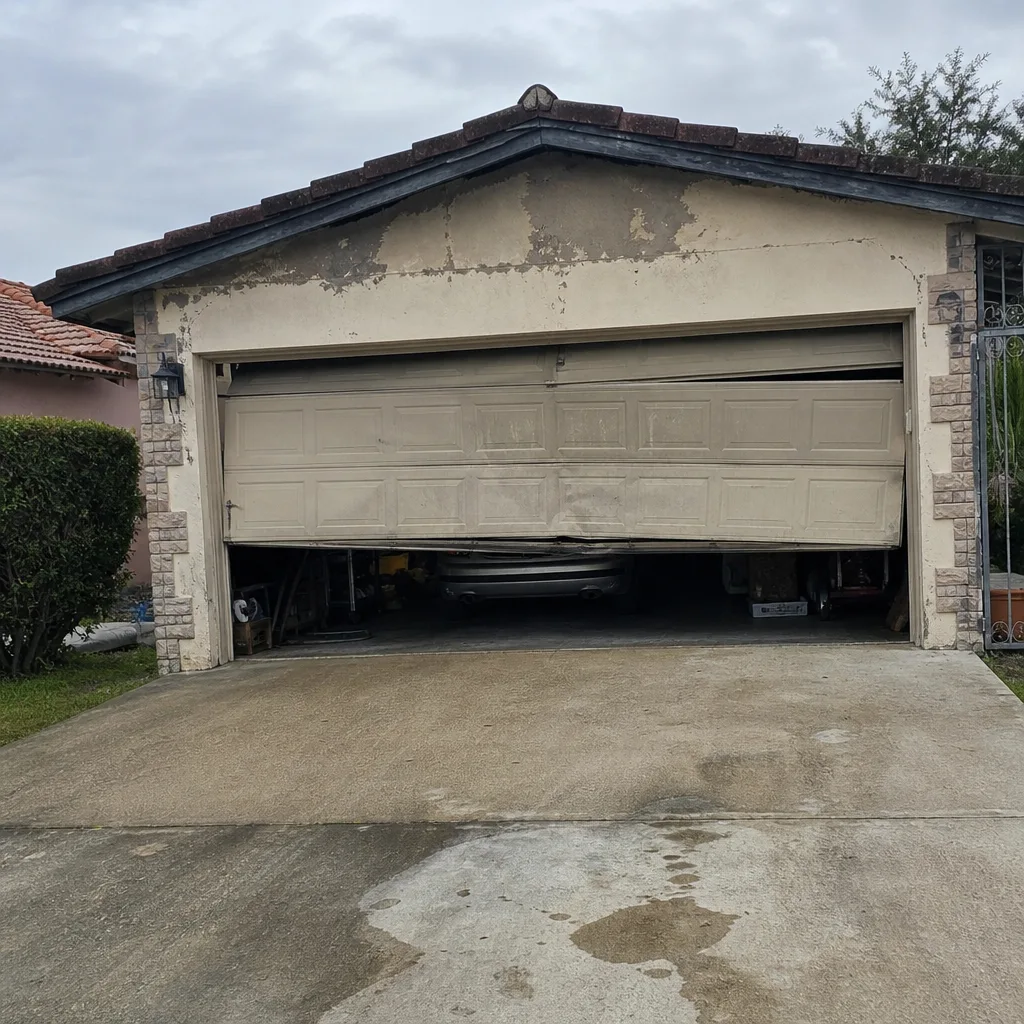 Before
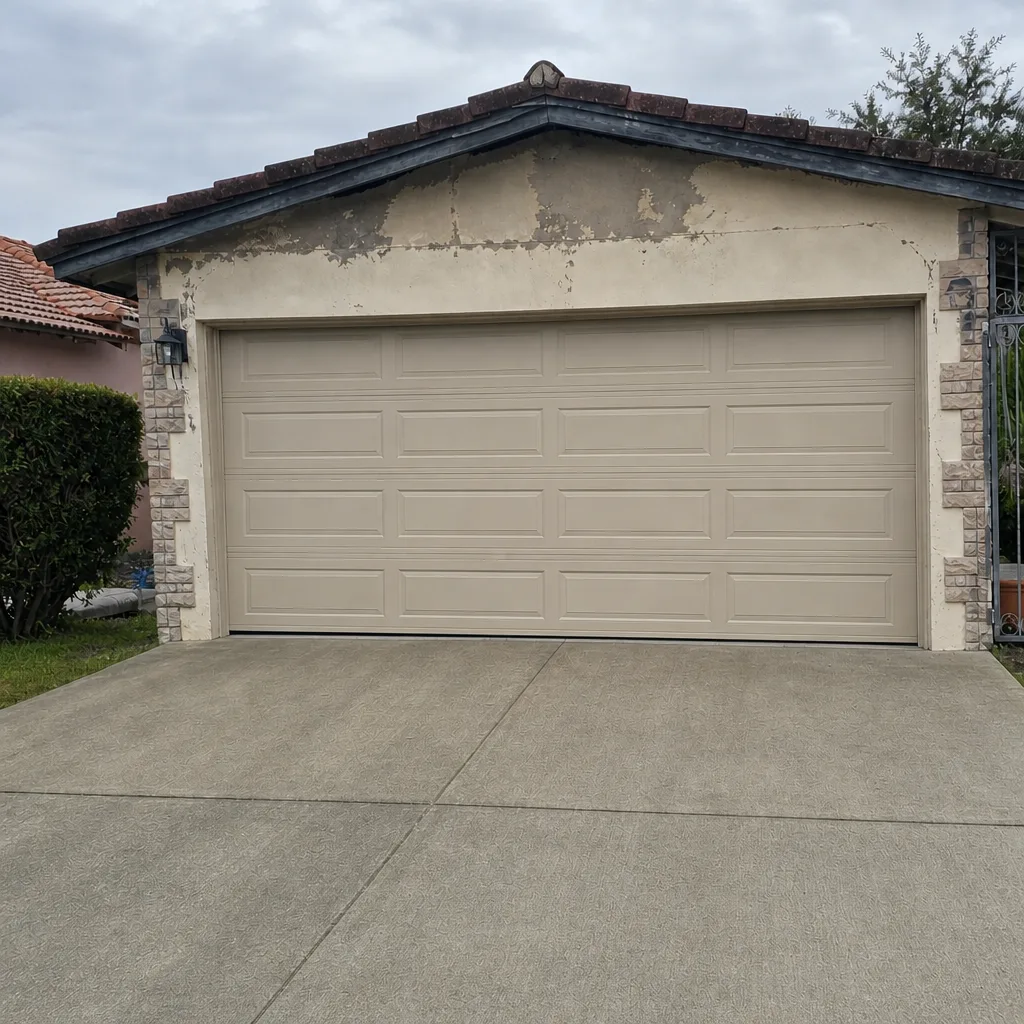 After
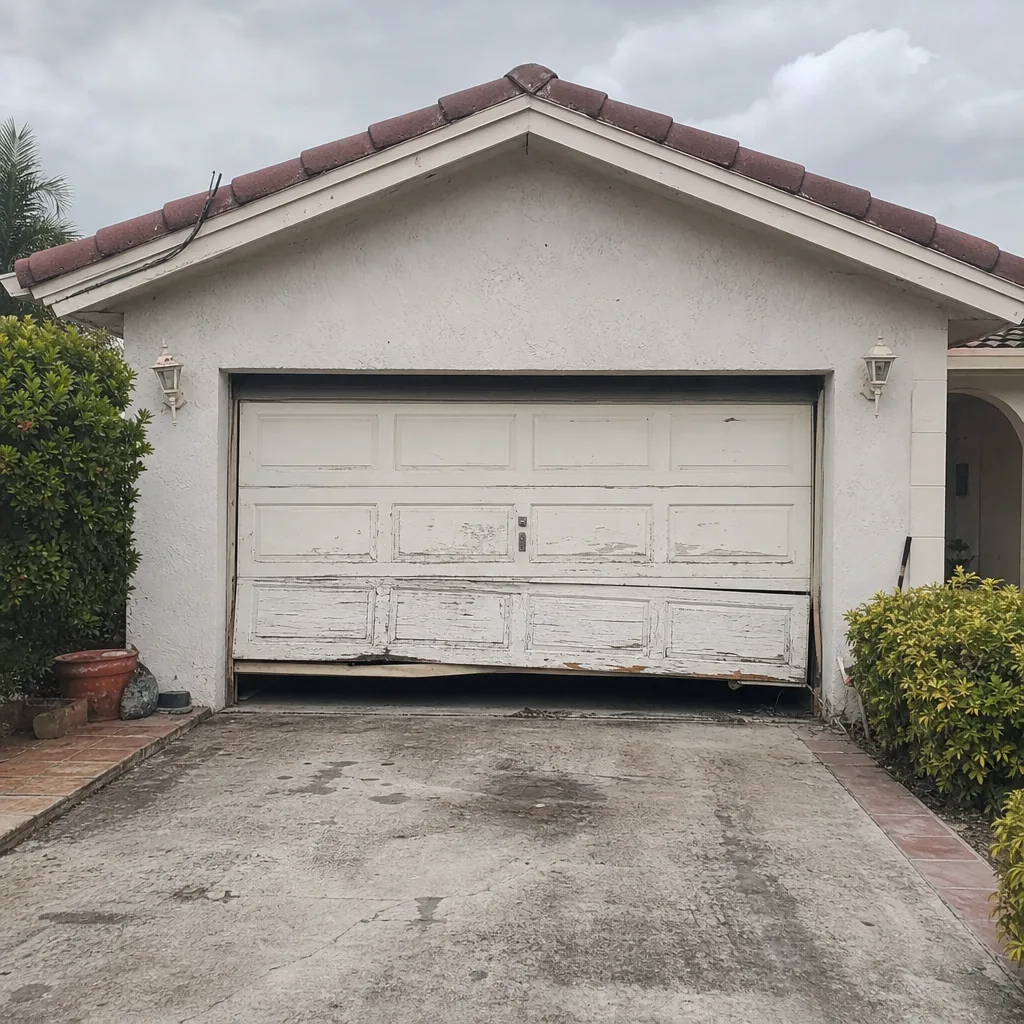 Before
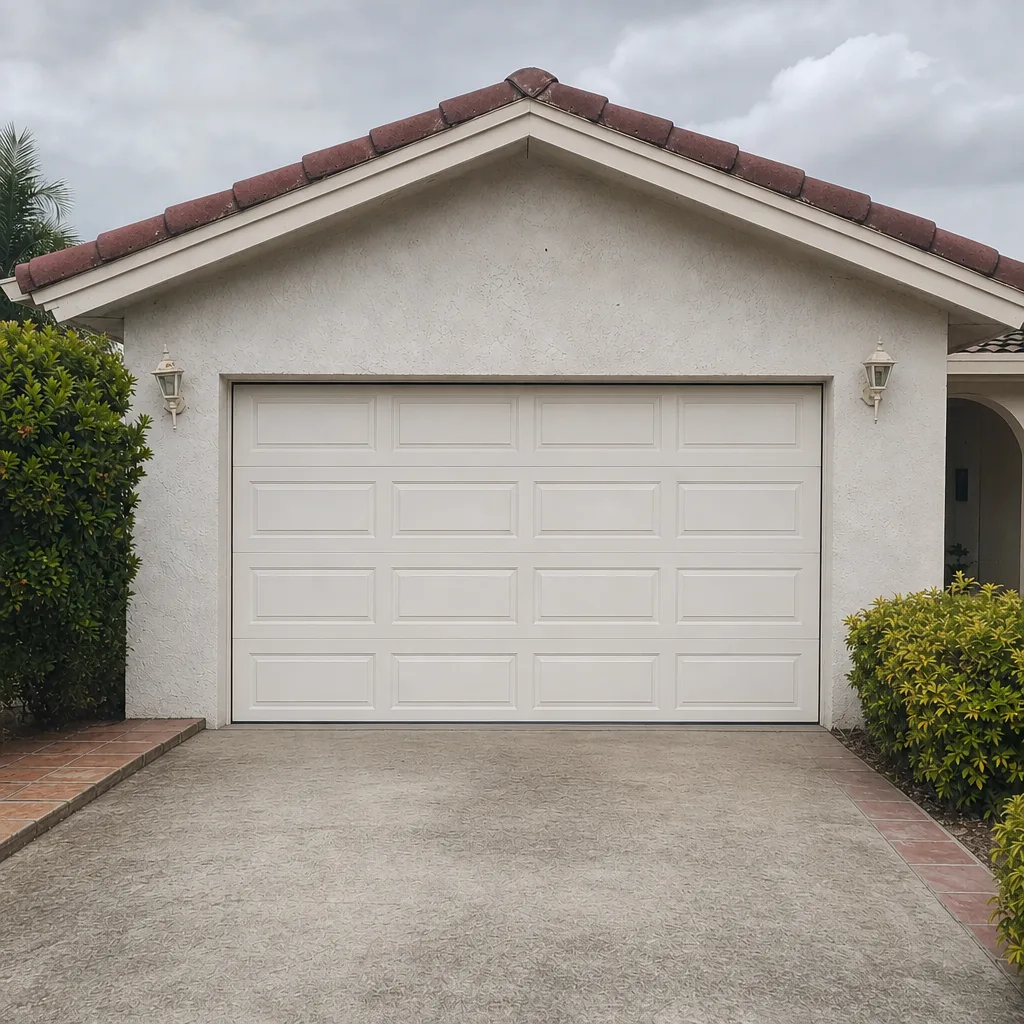 After
Common Mistakes to Avoid
- Assuming a slowed door is a tired opener. In Hialeah’s humidity, a slowed door usually means cable or drum friction, not an exhausted opener. Replacing the opener without checking the door’s movement just delays the real problem.
- Ignoring a new sound because the door still opens. A grinding sound that appears suddenly and stays consistent is a part wearing down. The door working today is not the same as the door being safe.
- Greasing the springs. Do not attempt to lubricate torsion springs. If you’re not sure, don’t touch them. The spring is the most dangerous component in the garage.
- Slackening or “adjusting” the torsion springs yourself. Torsion springs store enough energy to cause serious injury if the wrong tool slips or the wrong grip is taken. This is the one part of the door we always recommend leaving to a professional.
- Pulling the manual release on a door with a broken spring to “see if it opens.” If a spring has broken, releasing the door under a bound cable can let the door drop. Check the springs first.
- Calling a general handyman instead of a garage door specialist. A general handyman may not know the difference between an opener limit issue and a door friction issue, and on a Humid Hialeah door the two look the same on first glance.
- Waiting for a door that has left its track to “settle back.” A panel out of track is a hazard for anyone standing under it. Get it fixed before the door is used again.
When to Call a Professional
Call a professional the moment any of these is true: you’ve seen a gap in a torsion spring, a cable that’s gone slack, a door that won’t stay up, a door panel that’s left its track, or a grinding sound that has grown louder over a week. Those are the signs that mean the door is a hazard, not a scheduling item. Lower-level signs – a stable grinding, a slow section that hasn’t worsened, a remote that’s lagging – are worth a professional eye within a normal repair window. Hialeah Garage Door Repair Co offers free estimates in Hialeah, and our technicians have up to 13 years of experience across LiftMaster, Chamberlain, Genie, Clopay, Amarr, Wayne Dalton, Craftsman, and Raynor systems. Call (833) 309-5115 to book an inspection, and for doors that have failed hard, ask about emergency garage door service. We can also quote a full new door if the warning signs are pointing there – the Hialeah Garage Door Repair Co team handles both repair and installation, so you won’t need a second contractor if the door’s time is up.
Frequently Asked Questions
The first warning signs are usually sound and speed: a grinding or popping that wasn’t there before, and a door that has gotten slower. Check the springs for gaps and the cables for slack. If any spring or cable sign is present, stop using the door and call us at (833) 309-5115.
A spring that’s about to break usually shows a gap in the coil, pitting, or a bloom of rust along the wire, and the door may be lower on one side. Look from a step back and don’t touch the hardware. If you see any of those, call us for a free estimate – estimates are free and we get the door safe first.
Slow movement in Hialeah’s humidity usually points at cable or drum friction, not the opener. A sticky drum, a stretched cable, or a bound track forces the opener to work harder on one side, and the whole door slows. Have it checked – a slow door in this climate often fails sooner than a slow door in a dry one.
A stable grinding that’s been the same for weeks is a scheduled repair, not an emergency. A grinding that has appeared suddenly or grown louder over a week is worth a faster call. If the door is also slow, uneven, or has started to stop mid-travel, treat it as urgent and call.
A sharp snap followed by the door refusing to open, or a loud pop and the door dropping an inch, are signs a spring or cable has failed. If you hear either, don’t cycle the door – call us and we’ll get a technician out.
Yes. Emergency garage door service is a standing part of what we do, not an add-on. If your door has failed or is a hazard, call (833) 309-5115. Our technicians have up to 13 years of experience and are familiar with LiftMaster, Chamberlain, Genie, Clopay, and the other major brands.
The Bottom Line
Garage door failures in Hialeah are almost always telegraphed. Learn the four sounds, run the visual inspection on the springs and cables from a safe distance, watch the door’s speed, and read the opener’s behavior as a diagnostic signal. Those four habits will catch most problems with time to book a normal repair. When a spring, a cable, or a panel leaves the track, stop using the door and call. If you want an expert pair of eyes on your door, garage door spring repair and full spring inspections are our specialty, and we’re happy to walk the whole door with you. Call (833) 309-5115 for a free estimate.
Written by the team at Hialeah Garage Door Repair Co.